

The big ChatGPT-in-education study just got retracted.
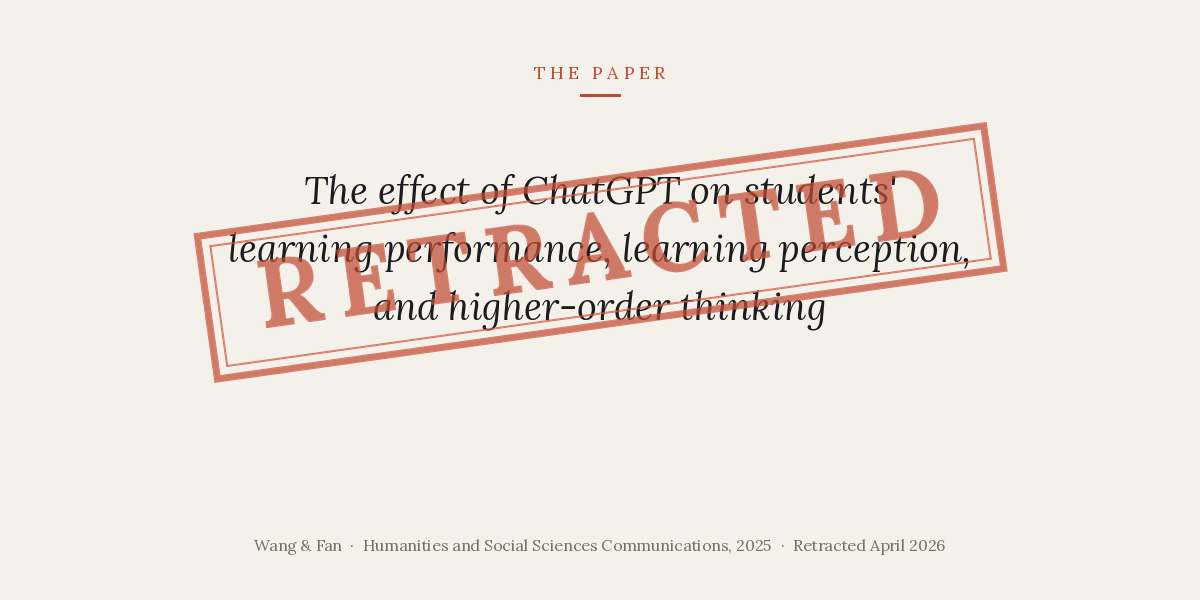
Springer Nature pulled a meta-analysis last month that claimed ChatGPT helps students learn. The paper had been cited hundreds of times. It was a year old. The journal said discrepancies in the analysis undermined their confidence in the findings. The authors didn't respond to the journal's correspondence about the retraction.
By the time the retraction went up, the original paper had nearly 10,000 reads and a 382 Altmetric score, which is a rough measure of how much a paper bounces around the press, social media, and policy circles. That's a year of being treated as evidence.
The retracted paper is a meta-analysis, meaning the authors didn't run a new study. They combined the results of 51 existing studies on ChatGPT in education, run between November 2022 and February 2025, and produced a single number for each outcome. They reported a large positive effect on learning performance and moderate effects on learning perception and higher-order thinking.
Meta-analyses are useful when they're done well. They smooth out the noise of any single study. They're also easy to break.
A retraction means the journal pulled the paper outright. The paper still exists on the publisher's site, but it's now stamped RETRACTED.
The retraction notice doesn't list specific errors. The editors say they found discrepancies in the meta-analysis and lost confidence in the analysis and its conclusions. They also note that the authors didn't respond to correspondence about the retraction.
That last detail lingers. When a journal tells two researchers they're pulling their year-old paper because the math doesn't hold up, and the researchers go quiet, that's not a small thing.
Springer Nature retracts papers all the time. What stands out here is the velocity.
The paper went up in May 2025 and came down in April 2026. In that year, it showed up in a lot of AI-in-education pitches. School districts cited it. Vendors cited it. By the time the editors pulled it down, the paper had already done the work somebody wanted it to do.
The gap between when a study is published and when the field has had a chance to vet it is where most of the AI-research credibility problems live. Peer review is slow. The hype cycle isn't.
If a vendor or a board sent you a deck quoting "studies show ChatGPT improves learning outcomes," that line might have been resting on this exact paper.
The retraction doesn't mean ChatGPT is useless, or that every study in the field is bad. It means a citation in a vendor deck is sales material. Treat it that way. How often a paper gets cited tells you it got around. Not whether it holds up.
I wrote about this from a different angle on Sunday, when an Oxford team showed that making AI models friendlier made them less accurate. Different mechanism, same lesson. AI marketing is moving faster than the research it leans on.
If a vendor cites a study while pitching you AI:
Ask who paid for the study. If the company selling the product also funded the research, you need a second opinion before you act on it.
Search Retraction Watch. It's a free site. Thirty seconds tells you whether the study still counts.
One study isn't enough. A real finding gets confirmed by other research groups doing the same kind of work. Treat anything that rests on a single paper as a maybe.
Ask for the link. "Studies show" without an actual citation is sales talk. If they can't point you to the paper, they don't have one.
I use AI tools daily and they save me real time. Heavily cited and true are different things, and the vendors selling you AI are counting on you to forget the difference.
Salespeople are still quoting this study. Sales decks don't get retraction-notices.
Source: Ars Technica covered the retraction.
The retraction: Springer Nature's official retraction notice (Wang & Fan, Humanities and Social Sciences Communications, 2025).